Abstract base class for Differential Evolution crossover strategies. More...
#include <Crossover.h>
Public Member Functions | |
| virtual | ~Crossover ()=default |
| Virtual destructor for safe polymorphic deletion. | |
| virtual void | crossover (std::vector< double > &target, const std::vector< double > &mutant, double cr, MersenneTwister &mt)=0 |
| Performs crossover between target and mutant vectors. | |
Detailed Description
Abstract base class for Differential Evolution crossover strategies.
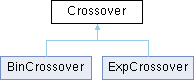
Crossover defines the interface for all DE crossover operators. Each concrete crossover strategy (BinCrossover, ExpCrossover) implements the crossover() method to recombine a target vector and mutant vector, creating a trial vector for evaluation.
Crossover Role in DE:
In Differential Evolution, crossover blends the target and mutant vectors:
- Start with target vector from current population
- Mix in parameters from mutant vector with probability CR
- Create trial vector for fitness evaluation
- Selection step compares trial vs target
Purpose of Crossover:
- Diversity Control: Crossover rate (CR) controls how aggressively new variation enters the population
- Inheritance: Selects which parameters to inherit from mutant
- Exploration-Exploitation Balance: Works with mutation (F) to control overall search behavior
Crossover Rate (CR) Semantics:
CR is a probability in range [0, 1]:
- CR = 0.0: No crossover, trial = target (no change)
- CR = 0.5: Each parameter has 50% chance to come from mutant
- CR = 1.0: All parameters from mutant (full replacement)
- Typical: 0.5-0.9 depending on problem
The pair (F, CR) controls search behavior:
- Mutation (F): Determines magnitude of variation in mutant
- Crossover (CR): Determines how much variation enters population
- Interaction: High F + High CR = aggressive exploration Low F + Low CR = conservative exploitation
Strategy Comparison:
Two main strategies:
- Binomial (Uniform): Each parameter independently inherited
- Exponential (Continuous): Parameters inherited in contiguous blocks
- See also
- BinCrossover for binomial (independent) crossover
- ExpCrossover for exponential (continuous) crossover
Member Function Documentation
◆ crossover()
|
pure virtual |
Performs crossover between target and mutant vectors.
Pure virtual method that each concrete crossover strategy implements to recombine a target vector and mutant vector. The target vector is modified in-place to become a trial vector.
Algorithm Pattern:
All crossover strategies follow this general workflow:
- Select at least one index jrand (ensures at least one parameter from mutant)
- For each parameter in target:
- With probability CR, inherit from mutant
- Otherwise, keep current value from target
- Parameter at jrand is always inherited (guarantees diversity)
- Return via in-place modification of target
In-Place Modification:
The target vector is modified directly, replacing its contents with the trial vector. This is efficient (no copy) and standard in DE.
Guarantees:
- Target vector is always modified (in-place)
- Trial vector dimension equals target and mutant dimension
- At least one parameter comes from mutant (jrand index)
- All other parameters inherit with probability CR
Parameters:
- Parameters
-
[in,out] target The target (parent) vector from current population. Modified in-place to become the trial vector. Size: equals mutant.size() and problem dimension. [in] mutant The mutant vector produced by mutation strategy. Used as source for inherited parameters. Size: equals target.size(). [in] cr Crossover rate (probability of inheritance). Range: [0, 1]. - cr = 0: Very few parameters from mutant
- cr = 0.5: About half parameters from mutant
- cr = 1.0: All parameters from mutant Typical values: 0.5-0.9.
[in,out] mt Mersenne Twister random number generator. Passed by reference; state is modified during execution. Used to randomly select parameters to inherit.
Strategy-Specific Behavior:
Different concrete strategies implement different inheritance patterns:
- Binomial: Each parameter independently chosen with probability CR
- Exponential: Parameters inherited in contiguous blocks
Postconditions:
After crossover completes:
- target vector contains trial vector (modified in-place)
- At least one parameter came from mutant (at index jrand)
- Other parameters inherited with probability CR
- target.size() unchanged
Usage in DE:
Complexity:
Time: O(dimension) - must examine each parameter Space: O(1) - modifies target in-place
- See also
- BinCrossover for independent parameter selection
- ExpCrossover for contiguous block selection
Implemented in BinCrossover, and ExpCrossover.
The documentation for this class was generated from the following file:
- src/opti_py/cpp/include/opti_py/Optimizer/DifferentialEvolution/Crossover/Crossover.h